Why Node.js is Perfect for Building Fast Web Applications
Hello readers, lately we have been discussing about node.js to build web applications and a lot of new developers, stay confused to what they should choose for their backend tasks.
Well you must have heard about node.js, and in this blog we would be discussing how it's a beast when it comes to build fast web applications.
What is Node.js ?
Before we discuss the potential of node.js, it is important that you are having a basic awareness of what node.js actually is.
Node.js is a run time environment for Javascript. Javascript which is the world's most popular language was designed to add interactivity to HTML pages. It was taken from the browser and made to run on servers and for that node.js was the one which provided it the environment that it required to run.
Node.js is built for speed because of three core things:
Uses the Google V8 engine (compiled execution)
Non-blocking I/O
Event-driven architecture
You can learn more about Node.js architecture in this blog.
Non Blocking I/O requests
One of the main issues that come with backend applications are that they are blocking in nature i.e. if there is one task going on, then other task cannot begin unless the ongoing task is complete. Such a behaviour is called as blocking I/O requests.
Traditional system like PHP and Java handled this problem by having threads, which means each task got assigned to a thread and the thread would be blocking in nature. This was a resource intensive process at times and in a way achieved parallelism.
Node.js is a runtime for javaScript and works on a single thread, so it could not achieve parallelism like others, but it used its event driven architecture. Again this blog could give you a deeper understanding of node.js architecture.
You can learn more about blocking and non blocking code in this blog.
Event Driven Architecture
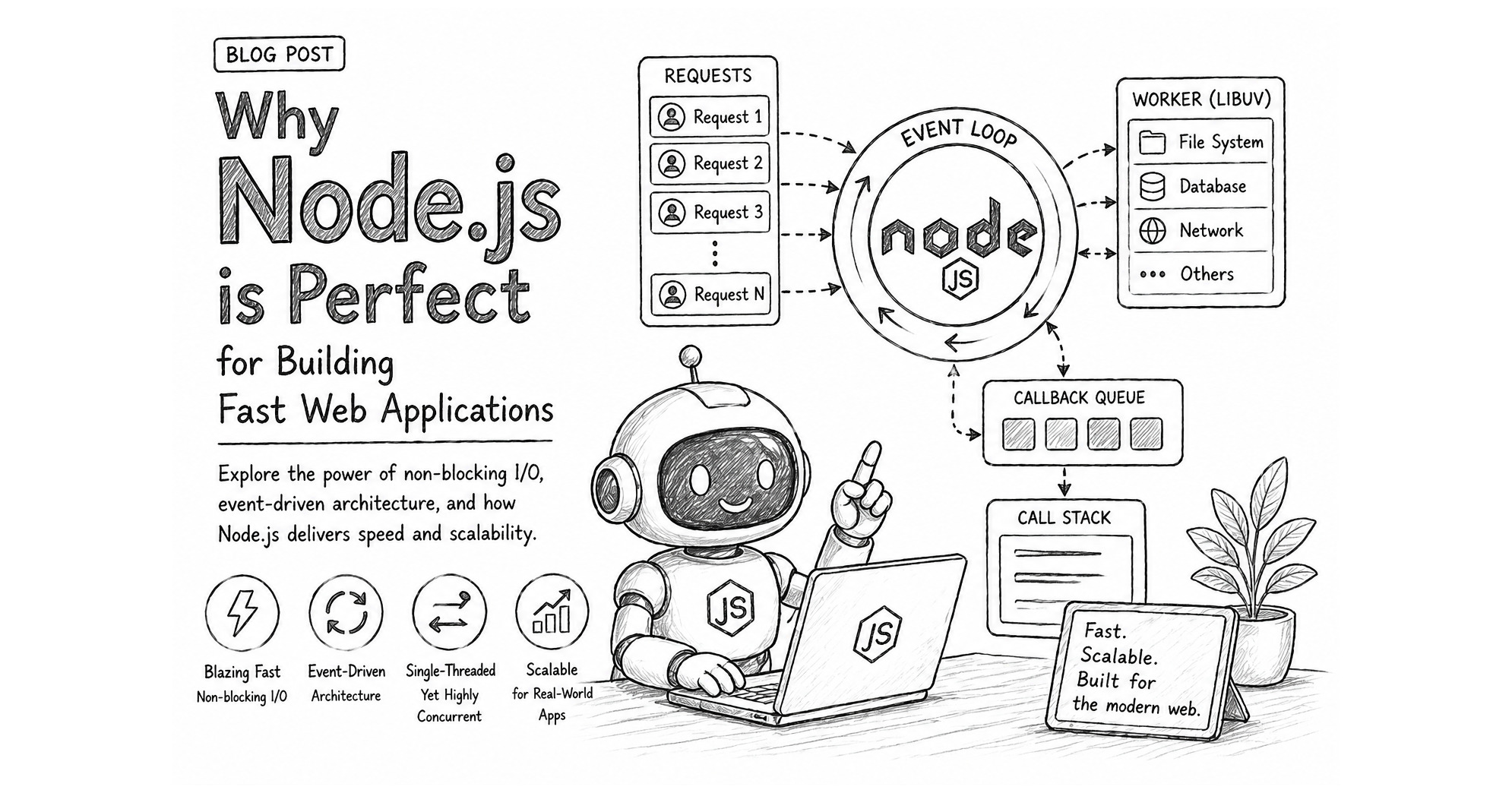
Node.js has an event driven architecture, which means it handles tasks which would consume its time through events. Node.js reacts to events instead of blocking the execution. This gives node.js the power of being asynchronous.
Event is a signal that something has happened in the system like a timer completing, a file being read, or a request being received.
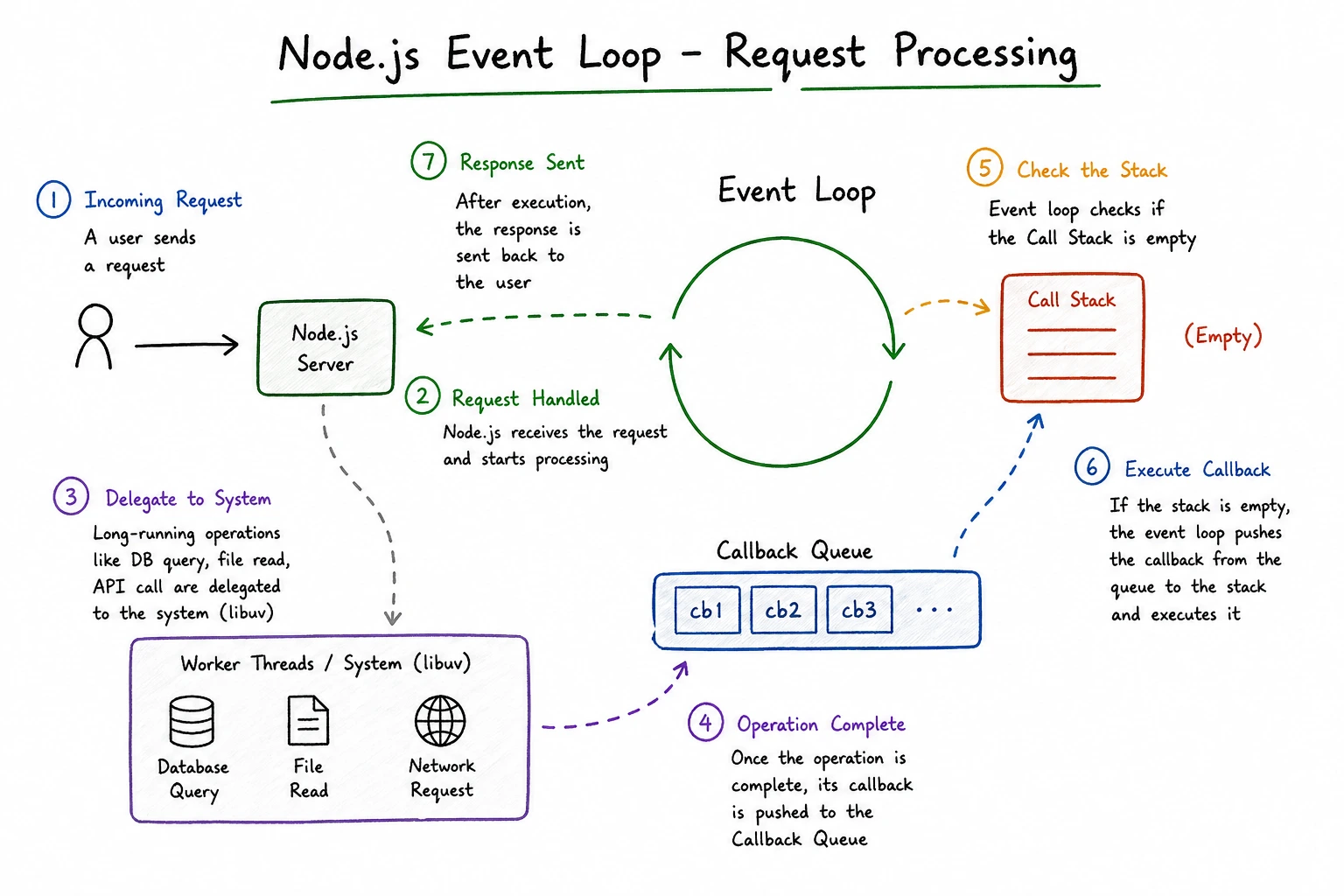
When an asynchronous operation (such as file reading, timers, or network requests) is initiated, Node.js delegates it to the system through libuv. Once the operation completes, its callback is placed into a callback queue. The event loop, managed by libuv, continuously checks the call stack. When the call stack becomes empty, it takes the next callback from the queue and pushes it onto the stack for execution. This mechanism allows Node.js to handle multiple operations efficiently without blocking, enabling high concurrency.
Single-threaded model explanation
In earlier section I said that node.js run on a single thread, isn't it surprising that something which can run on a single thread claims to handle thousands of requests?
It is able to achieve that by:
Delegating heavy work to system threads
Using event loop to manage tasks
const http = require("http");

http.createServer((req, res) => {
  setTimeout(() => {
    res.end("Response after delay");
  }, 2000);
}).listen(3000);

console.log("Server running...");
Multiple users could hit the server, even if it is running on a single thread because non of the code is blocking in nature.
Concurrency vs Parallelism (Simple Code View)
Concurrency = managing multiple tasks
Parallelism = executing tasks at same time
Example
// Concurrency (Node.js style)
setTimeout(() => console.log("Task 1"), 2000);
setTimeout(() => console.log("Task 2"), 1000);

console.log("Both tasks scheduled");
Output:
Both tasks scheduled
Task 2
Task 1
Analogy
Taking multiple orders = concurrency
Cooking multiple dishes simultaneously = parallelism
Tasks overlap without blocking, Node.js does not have parallelism but it does support concurrency to a great extent.
Where Node.js performs best ?
Node.js is a beast when it comes to developing web applications at a great pace, but if it's that great then why does it have alternatives to it, why are people still keeping PHP and java alive. Because even Node.js has it's limits.
Node.js shines when:
Lots of I/O operations
Many simultaneous users
Real-time systems
This makes Node.js ideal for:
Real-time apps (chat, notifications)
APIs handling many requests
Streaming services
Microservices
It shines because of it's non-blocking event driven architecture where it can just outsource tasks which are taking time and focus on attending requests from others.
However it is not very ideal for Heavy CPU tasks (like video encoding).
Companies using Node.js
You might still doubt the wisdom I imparted, so below is a small list of the companies which use Node.js, I am sure, you must have heard atleast one of them:
Netflix → handles millions of streams
Uber → real-time ride matching
PayPal → faster API performance
LinkedIn → scalable backend
Conclusion
In this blog, you have understood in very simple terms how node.js is an absolute gem when it comes to building web applications fast. You need not worry much about blocking user requests when node.js handles a very large chunk of that part.
Another popular reason for using Node.js could be because it is a JavaScript runtime, you use JavaScript heavily in building frontend applications. so understanding and learning JS could further speed your Node.js journey.


